\(\textbf{y}\) = vector of home range sizes of coyotes \(\beta_0\) = intercept \(\beta_1\) = effect diff. of HR size for urban coyotes \(\textbf{x}\) = indicator of HR in urban (1) or not in urban (0) \(\sigma^2\) = uncertainty / unknown variability
\(\beta_1\) is negative and statistically clearly different1 than zero
Prediction
Definition
The expected outcome from a hypothesis. If agrees with data, it would support the hypothesis or at least not reject it.
Example 1
Okay: Coyote home ranges are smaller in urban areas compared to non-urban areas
Example 2
Better: Coyote home ranges in urban areas with high available food resources are smaller than coyote home ranges in urban areas with low available food resources and smaller than coyotes living in non-urban areas
In regard to data and statistical models, 21st century scientists should be pragmatic, excited, and questioning.
How and why did these data come to be?
understand how the data came to be
ask this even when you design the study, after data collection
The Questioning Scientist
In regard to data and statistical models, 21st century scientists should be pragmatic, excited, and questioning.
What do these data look like?
visualize the data in many dimensions
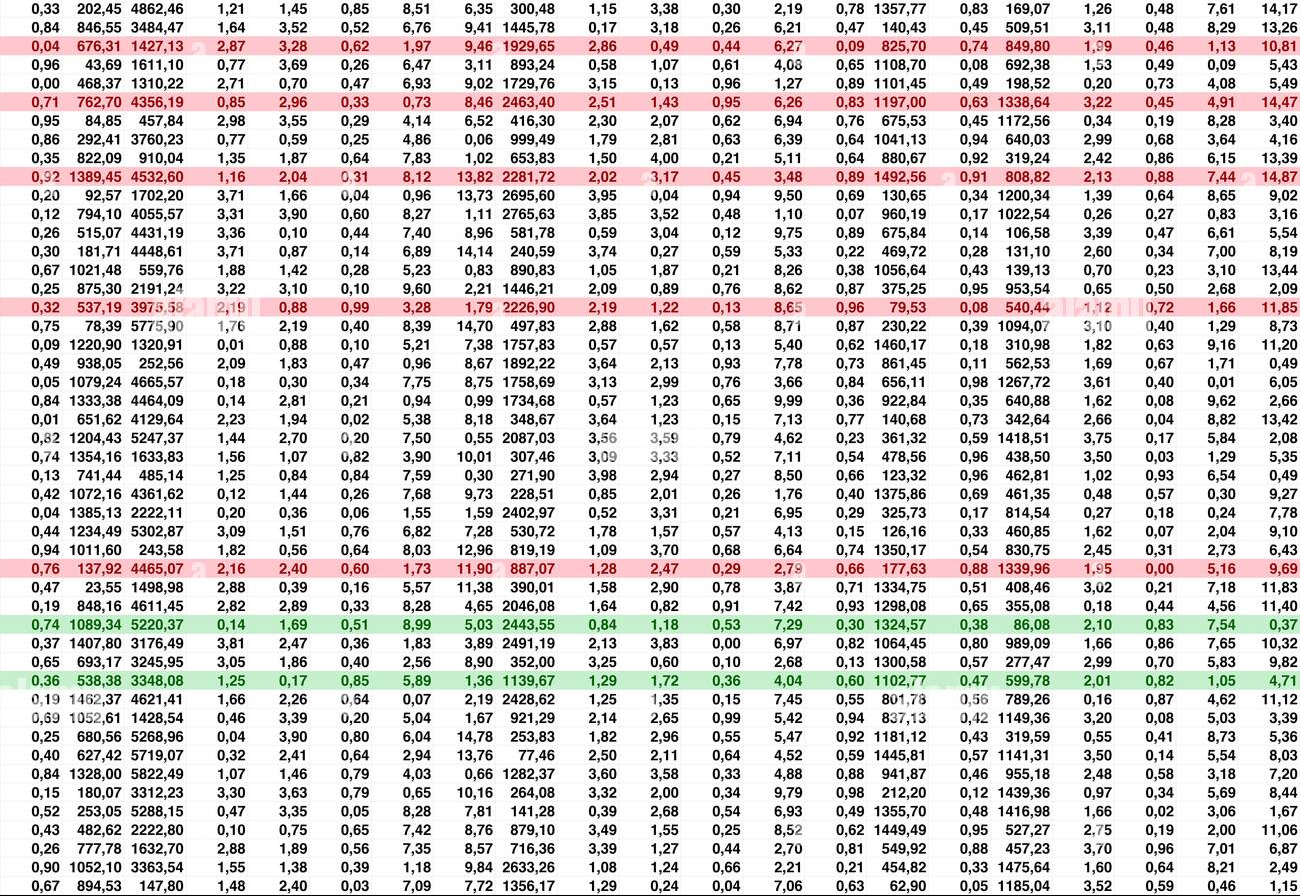
keep in mind - not all outcomes are visible in data – example?
The Questioning Scientist
In regard to data and statistical models, 21st century scientists should be pragmatic, excited, and questioning.
How does this statistical model work?
statistical notation, explicit and implicit assumptions, optimization
The Questioning Scientist
In regard to data and statistical models, 21st century scientists should be pragmatic, excited, and questioning.
How does this statistical model fail in theory and in practice?
statistical robustness and identifiability
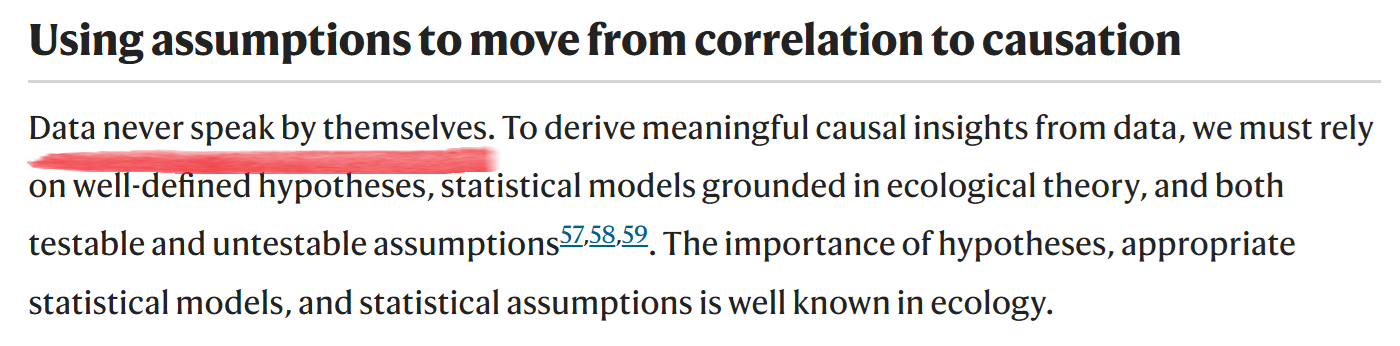
Data vs. Information
Data = Numbers/Groupings
Data ≠ Information
Statistical thinking: data contain information, depending on
the question being asked of the data
how the data came to be
The question and the data
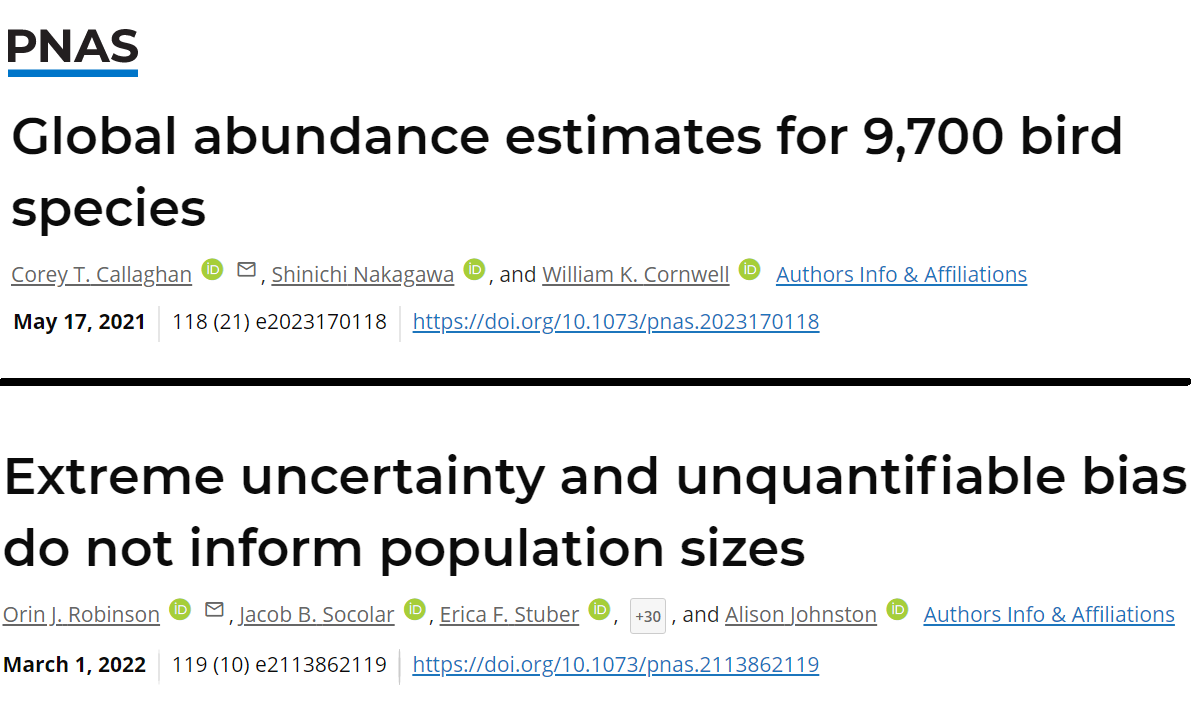
Surveillance monitoring data will generally have lower quality information to answer post-hoc hypotheses when compared to a designed study with a priori hypotheses.
The goal of the question
learn about the data (data summary)
apply learning outside of the data to a ‘population’ (inference)
learn about conditions relevant to but not observed in the data (prediction)
inference and prediction are different goals, optimally requiring different data, statistical modeling proecdures.
inference relies on probabilistic assigning some units to be in the sample (e.g., random sampling).
Design-Based
the values themselves are held to be fixed, whereas the sampling process is random.
Two types of Inference
Design-Based
Key Strengths: the population of interest is often defined (e.g., grid area); does not relying on stochastic models representing the structure of the data for reliable inference
Key Weaknesses: limited in application; still requires models to accommodate observational processes, such as detection probability
Design-Based
\(\textbf{Y}\) = [\(y_1\),…,\(y_N\)]
\(\textbf{y}\) = [\(y_1\),…,\(y_n\)]
Design-Based
\(\textbf{Y}\) = [\(y_1\),…,\(y_N\)]
\(\textbf{y}\) = [\(y_1\),…,\(y_n\)]
The population mean is \(\bar{Y} = \sum_{i=1}^N Y_i / N\) and the sample mean is \(\hat{\bar{y}} = \sum_{i=1}^n y_i / n\)
The population mean describes ….?
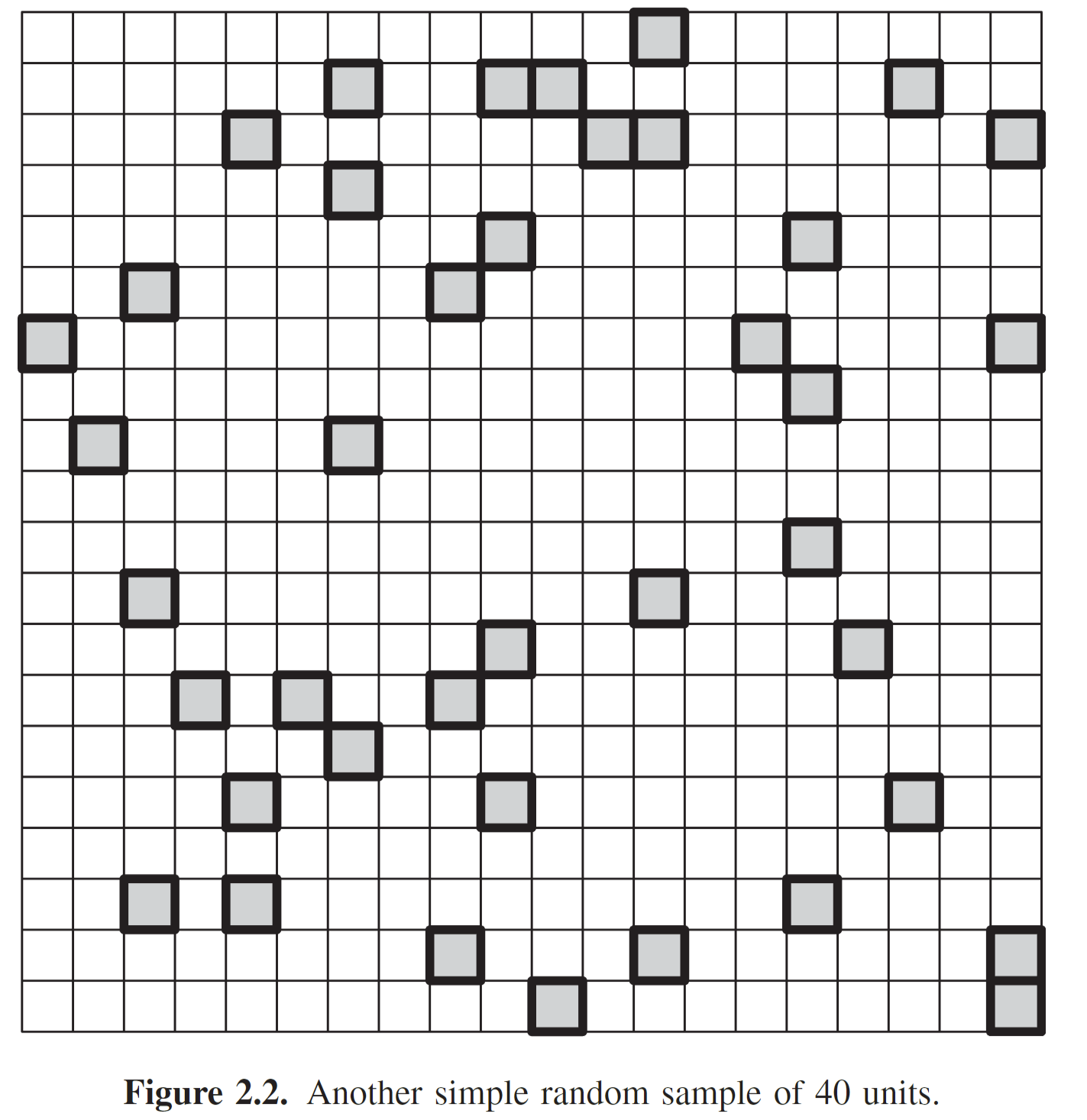
\(\textbf{y}\) is a random vector that has \(n\) random values, e.g., one sample of 4 cells.
Wikipedia: A random variable (also called ‘random quantity’ or ‘stochastic variable’) is a mathematical formalization of a quantity or object which depends on random events.
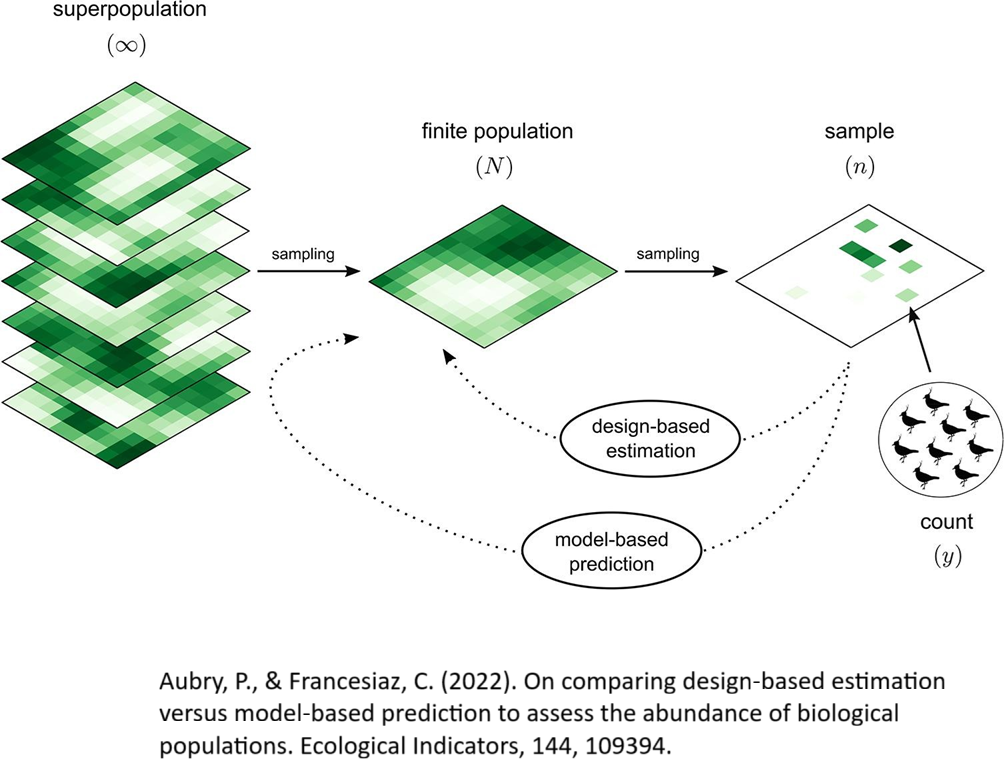
We observe samples from the domain or population or sampling frame.
Samples are observed with some probability.
Statistic
\(\hat{\bar{y}}\) is a ‘statistic’ (# computed from a sample) and is also a random variable
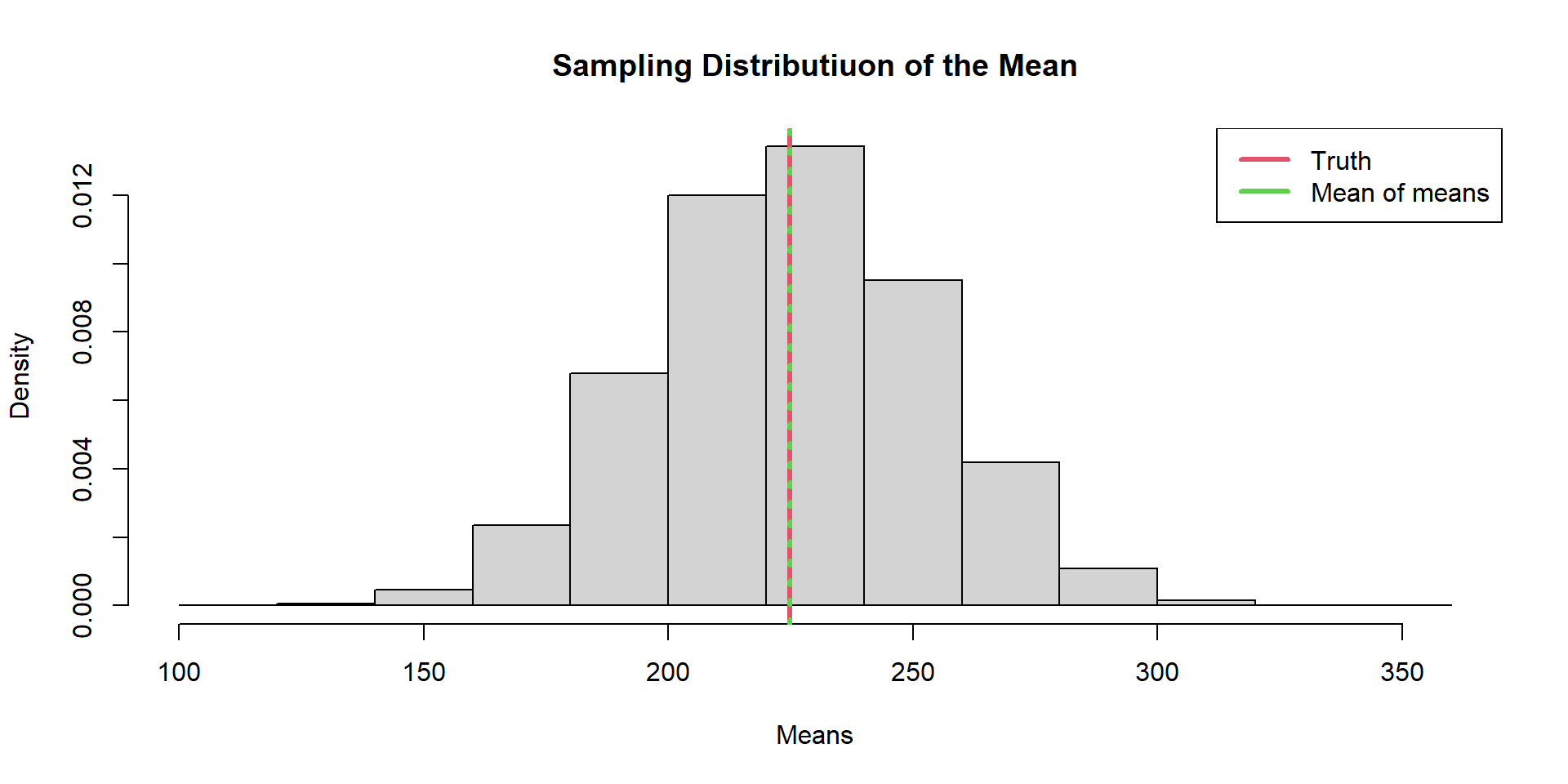
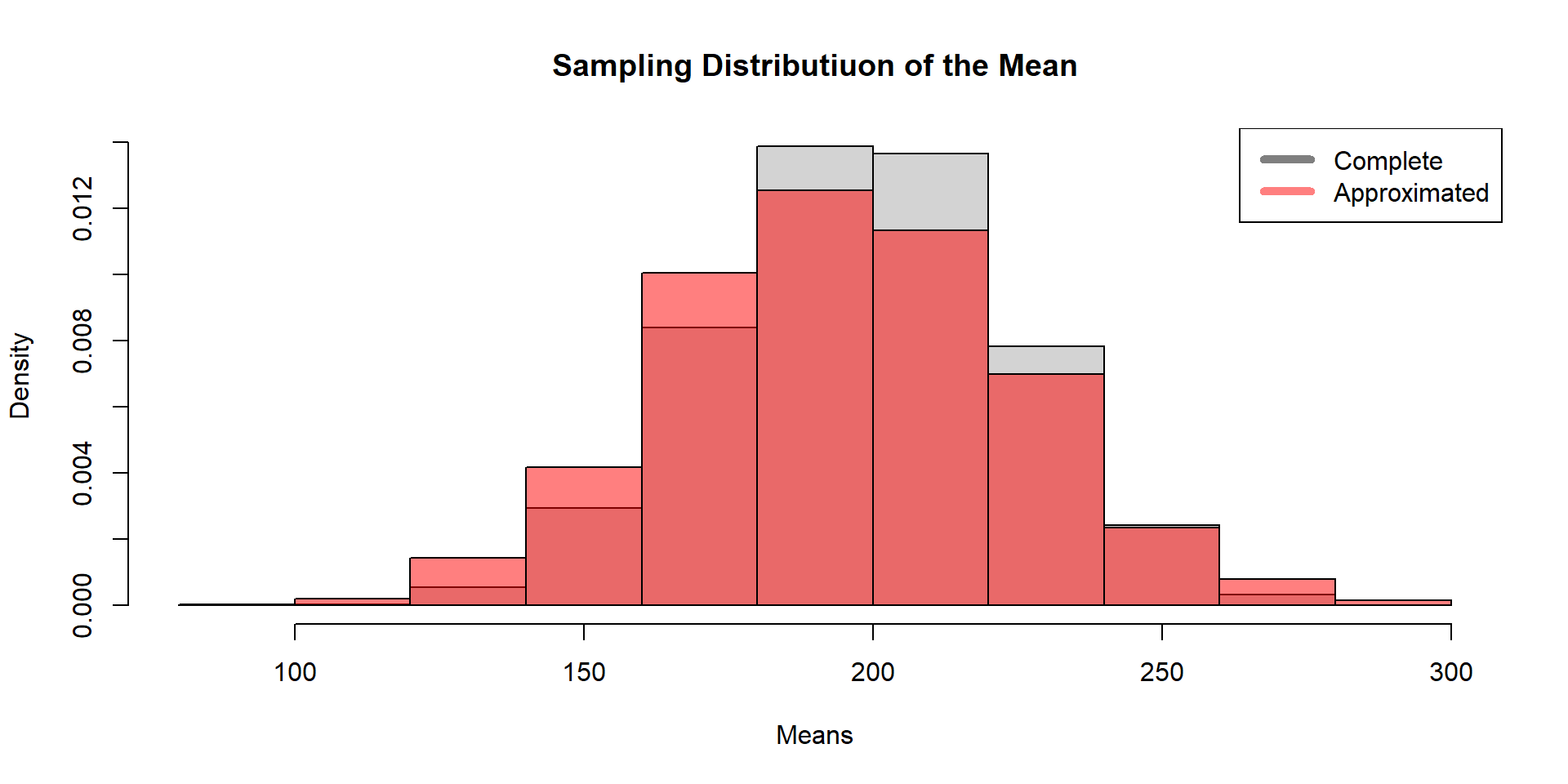
statistics have a sampling distribution, describing the probability associated to observing different values of the statistic
Design-Based Code
TRUTH
# Random discrete uniform samplerrdu <-function(n, lower, upper){sample(lower:upper, n,replace=TRUE ) }N =25# This is our truth, which we will sample fromset.seed(4343)mat =matrix(rdu(N, lower =0, upper =400 ),nrow =5, ncol =5 )
“a statistical model describing how observations on population units are thought to have been generated from a super‐population with potentially infinitely many observations for each unit;”Williams and Brown, 2019
“The analysis need not account for sampling randomization, because the sample is considered fixed. However, the unit values are considered random.”Williams and Brown, 2019
Model-Based
BUT….
when linking ‘unit values’ in a model, we need to account for their dependence.
Randomization allows us to make conditional independence claims among data in our sample, thus the model is simpler.
\(P(y_{2}|y_{1}) = P(y_{2})\)
Model-Based
Key Strengths: Very flexible. Modeling is magic.
Key Weaknesses:
Can be difficult to assess assumptions
Sampling frame is not always clear and thus the population you are infering to is not entirely clear
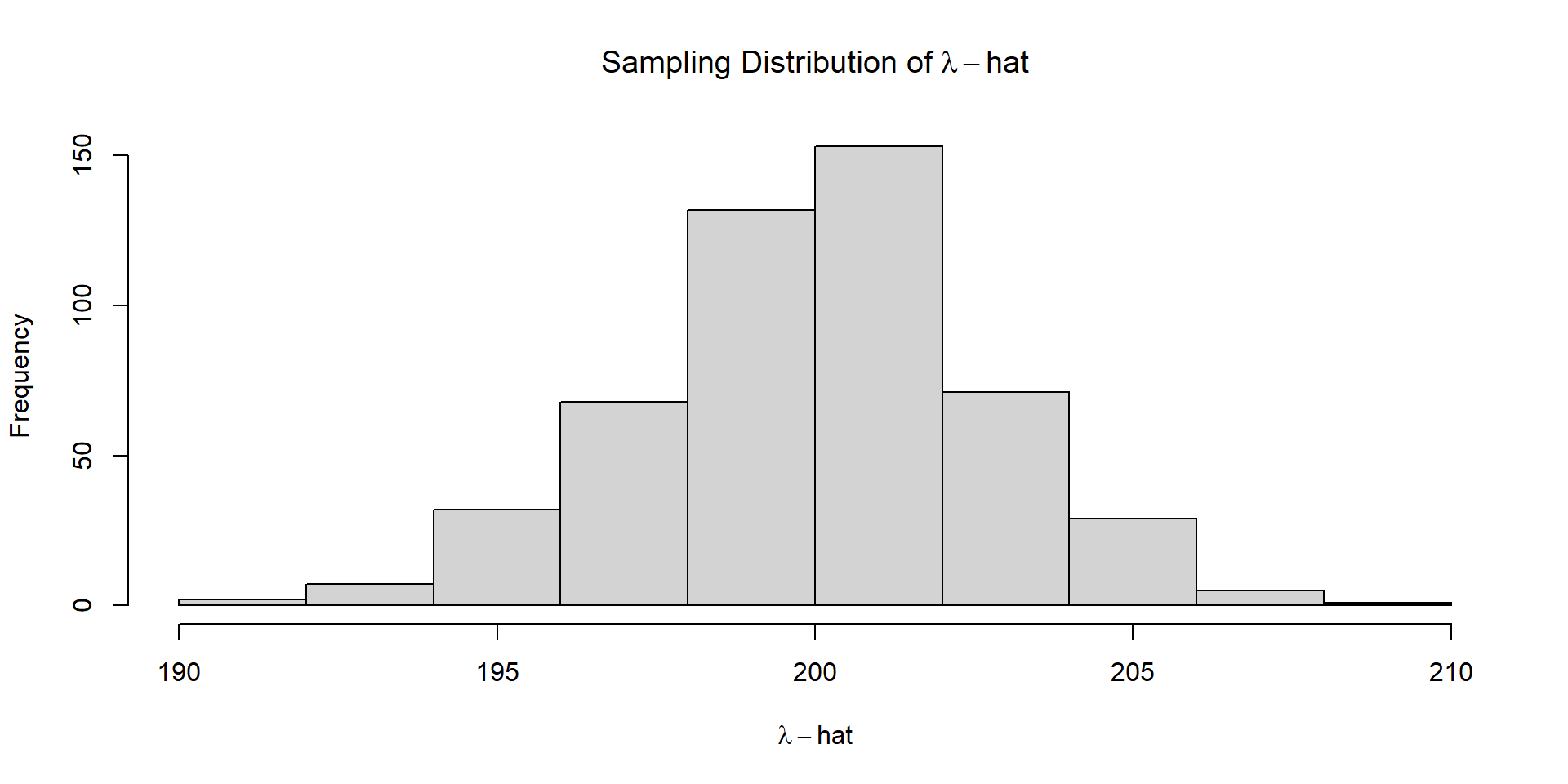
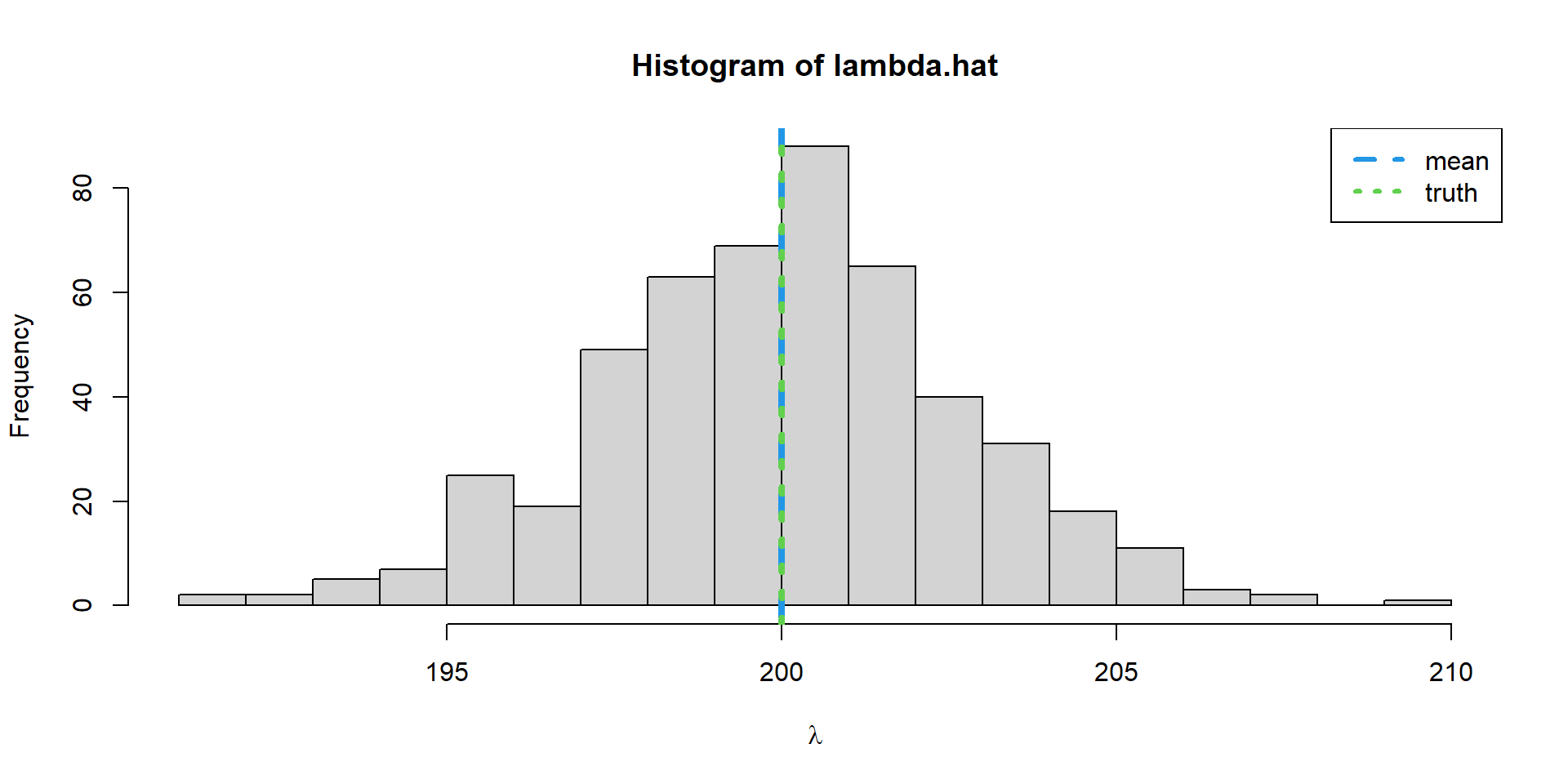
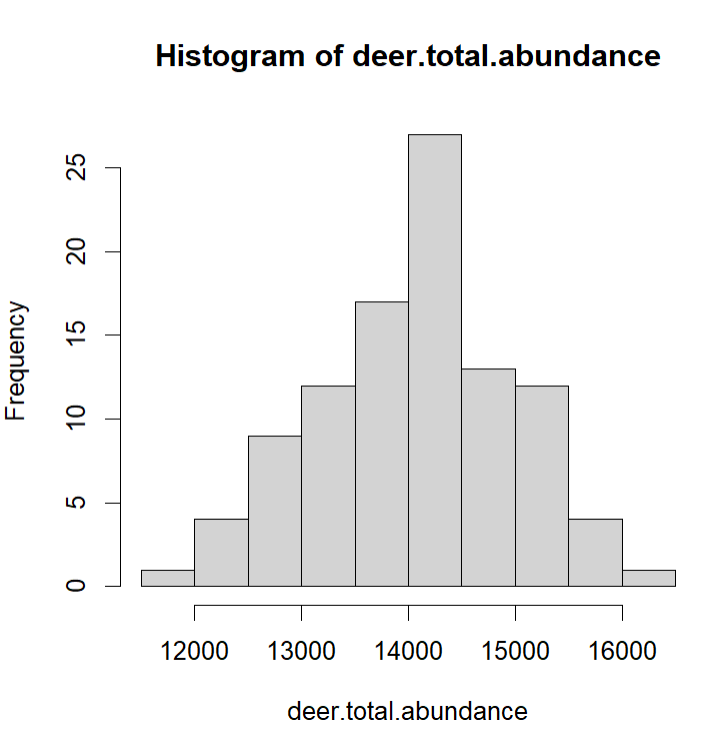
What is the probability that we will observe a mean within 5% of the truth?
We can calculate this using Monte Carlo integration
diff =0.025*lambda diff
[1] 5
lower = lambda-diff upper = lambda+diff index =which(lambda.hat>=lower & lambda.hat <= upper)# Probability of getting a mean within 5% of the truthlength(index)/length(lambda.hat)
[1] 0.715
Take-Aways
1.Study Objectives, Hypotheses, and Predictions
2.Big Data and Sampling
3.Inference and Prediction
4. Model-Based vs Design-Based Inference
Lab
Objectives
Introduce R Markdown
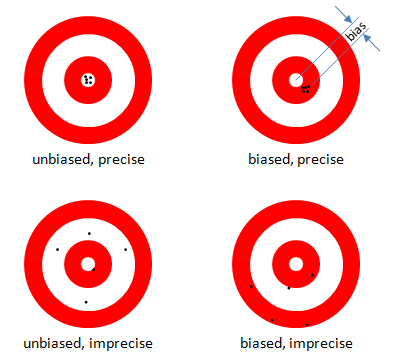
Use simulation and design-based sampling to investigate bias and precision
Lab Setup
Let’s add some more reality in our work while using design-based sampling in R.
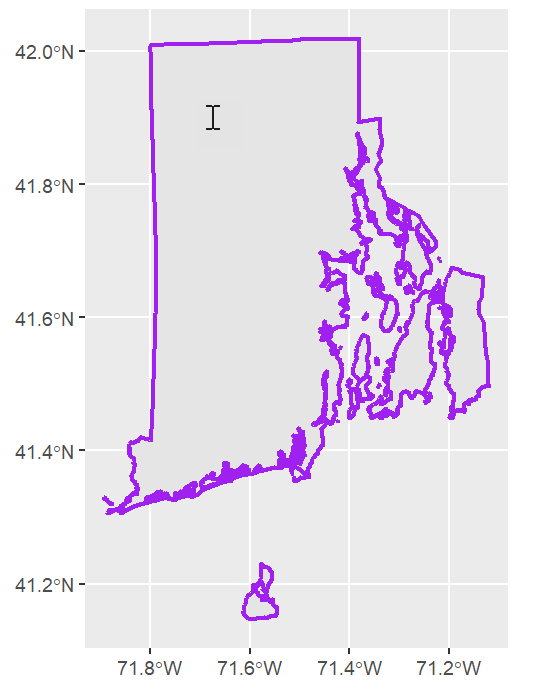
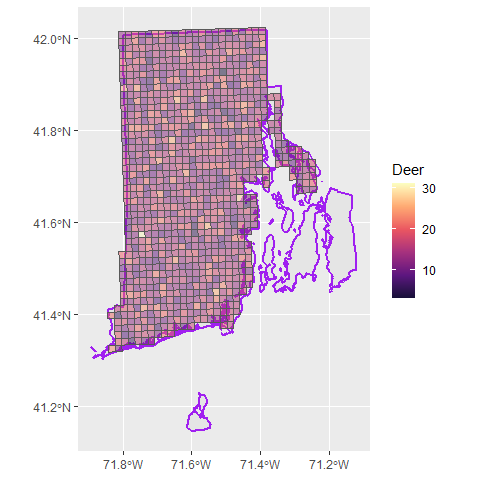
Objective: Evaluate sample size trade-offs for estimating white-tailed deer abundance throughout Rhode Island.
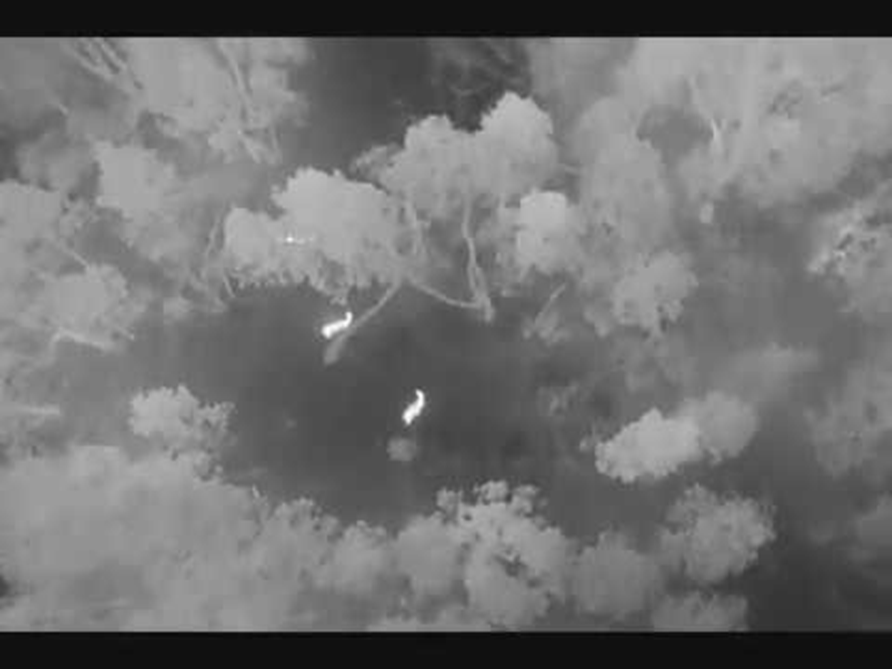
Methodology: Count deer in 1 sq. mile cells using FLIR technology attached to a helicopter.
Lab Setup
Steps to consider
Sampling Frame
all of RI or some subset
Lab Setup
Steps to consider
“Truth”
how many deer per cell; how variable
Lab Setup
Steps to consider
Sampling Process
how to pick each cell
Lab Setup
Steps to consider
Estimation Process
estimate total deer population from the sample
Criteria to Evaluate
use sampling distribution of deer abundance estimate or some other statistic